Research
Nonlinear and ultrafast photonics
Can the environment itself be changed faster than the matter inside it can respond?
Extreme confinement creates enormous fields, gradients, and energy densities in nanoscale volumes. In our nanogap cavities, a few nanometers of ordinary dielectric become an efficient source of harmonic generation; several nonlinear processes can be driven and controlled in a single cavity at once; and a material with no second-order response in the bulk, diamond, becomes a bright source of second-harmonic light. Arrayed into metasurfaces, the same cavities become devices — ultrafast thermal detectors, surfaces whose light–matter coupling can be tuned in real time, nanoscale frequency converters.
What happens in the first femtoseconds after light enters a nanogap cavity is much less explored than the steady state. We are building a femtosecond pump–probe laboratory, coupled to single-photon detection, to follow how energy moves through these systems from the moment of excitation. A longer-term question is whether the cavity itself can be changed faster than the matter inside it can respond.
Key papers
- A metasurface-based diamond frequency converter using plasmonic nanogap resonators
Q. Shen, A. Shams-Ansari, A. M. Boyce, N. C. Wilson, T. Cai, M. Loncar, M. H. Mikkelsen, Nanophotonics 10, 589–595 (2021) · DOI - Active control of multiple, simultaneous nonlinear optical processes in plasmonic nanogap cavities
Q. Shen, W. Jin, G. Yang, A. W. Rodriguez, M. H. Mikkelsen, ACS Photonics 7, 901–907 (2020) · DOI - Probing the origin of highly-efficient third harmonic generation in plasmonic nanogaps
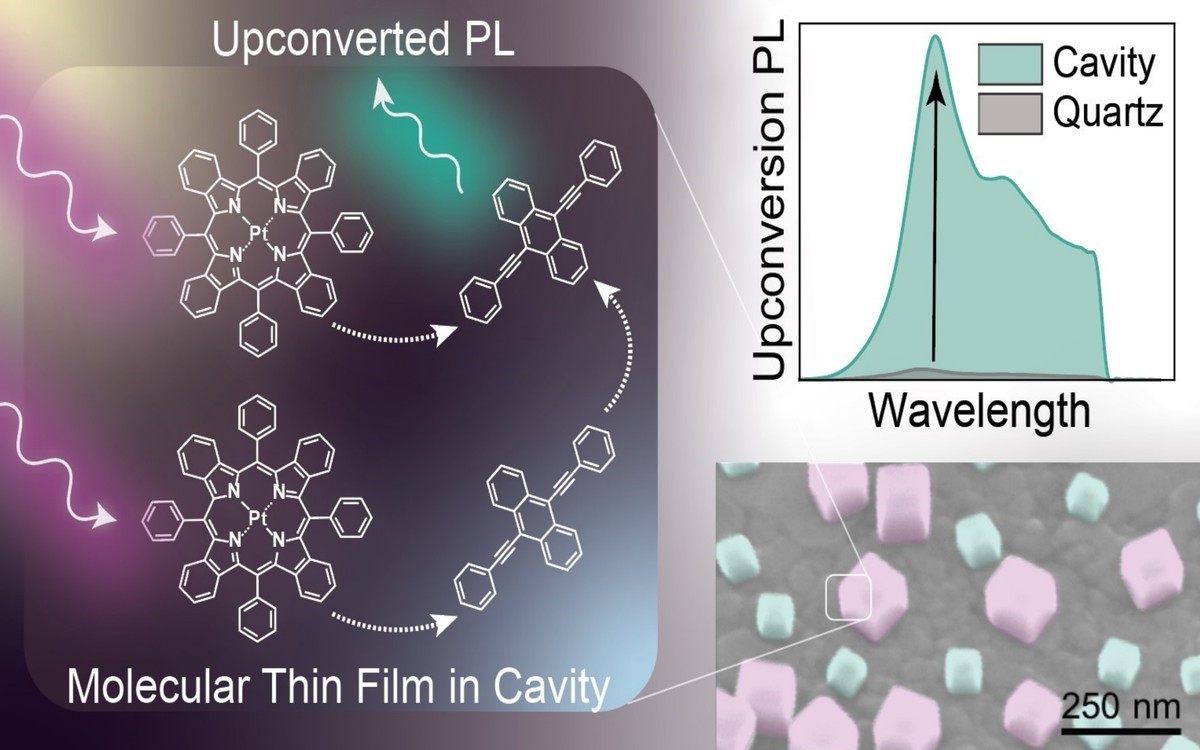
Q. Shen, T. B. Hoang, G. Yang, V. D. Wheeler, M. H. Mikkelsen, Optics Express 26, 20718–20725 (2018) · DOI - Uncovering the mechanisms of triplet-triplet annihilation upconversion enhancement via plasmonic nanocavity tuning
R. E. Bangle, H. Li, M. H. Mikkelsen, ACS Nano 17, 24022–24032 (2023) · DOI - Real-time tunable strong coupling: from individual nanocavities to metasurfaces
J. Huang, A. J. Traverso, G. Yang, M. H. Mikkelsen, ACS Photonics 6, 838–843 (2019) · DOI - Ultrafast pyroelectric photodetection with on-chip spectral filters
J. W. Stewart, J. H. Vella, W. Li, S. Fan, M. H. Mikkelsen, Nature Materials 19, 158–162 (2020) · DOI - Metasurface-enhanced thermal photodetector operating at gigahertz frequencies
E. Shin, R. E. Bangle, N. C. Wilson, S. B. Nikodemski, J. H. Vella, M. H. Mikkelsen, Advanced Functional Materials 36, 2420953 (2026) · DOI - Actively tunable metasurfaces via plasmonic nanogap cavities with sub-10 nm VO2 films
A. M. Boyce, J. W. Stewart, J. Avila, Q. Shen, S. Zhang, V. D. Wheeler, M. H. Mikkelsen, Nano Letters 22, 3525–3531 (2022) · DOI
The other questions
- Atomic-scale nanophotonics — How are the rules of light–matter interaction rewritten when the field varies across a single emitter?
- Quantum light–matter interactions — What can a single emitter do when the vacuum around it is engineered?
- Quantum and 2D materials in nanogaps — Can a nanogap drive a material into states it cannot reach on its own?