Research
Atomic-scale nanophotonics
How small can an optical cavity become — and what changes when it does?
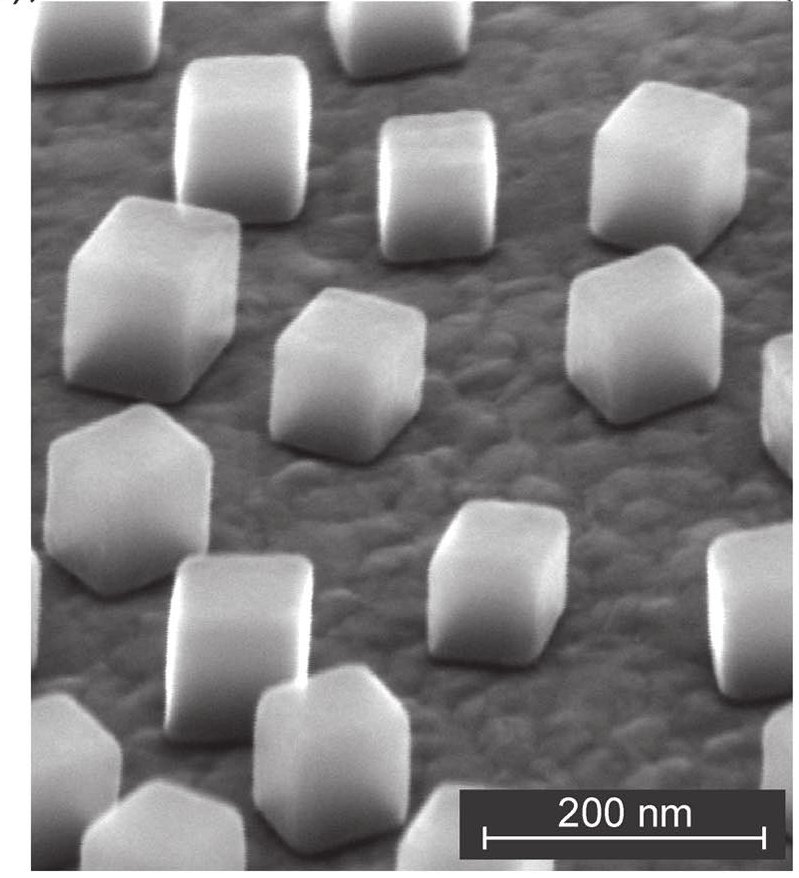
We design and fabricate optical cavities with gaps of a few nanometers, where light is confined to volumes millions of times smaller than a cubic wavelength. In this regime the usual rules of light–matter interaction stop applying: field gradients couple to transitions that are dipole-forbidden, the vacuum becomes strongly anisotropic, and the cavity’s own structure — down to the last nanometer — becomes a design variable.
We map these new rules experimentally, using the statistics of thousands of deterministically fabricated devices rather than one device at a time, and use them to create light–matter interactions that have no counterpart in free space.
Key papers
- Probing the mechanisms of large Purcell enhancement in plasmonic nanoantennas
G. M. Akselrod, C. Argyropoulos, T. B. Hoang, C. Ciraci, C. Fang, J. Huang, D. R. Smith, M. H. Mikkelsen, Nature Photonics 8, 835–840 (2014) · DOI - Extreme nanophotonics in ultrathin metallic junctions
J. J. Baumberg, J. Aizpurua, M. H. Mikkelsen, D. R. Smith, Nature Materials 18, 668–678 (2019) · DOI — review - Control of radiative processes using tunable plasmonic nanopatch antennas
A. Rose, T. B. Hoang, F. McGuire, J. J. Mock, C. Ciraci, D. R. Smith, M. H. Mikkelsen, Nano Letters 14, 4797–4802 (2014) - Large-area metasurface perfect absorbers from visible to near-infrared
G. M. Akselrod, J. Huang, T. B. Hoang, P. T. Bowen, L. Su, D. R. Smith, M. H. Mikkelsen, Advanced Materials 27, 8028–8034 (2015) · DOI — front cover article
The other questions
- Quantum light–matter interactions — What can a single emitter do when the vacuum around it is engineered?
- Nonlinear and ultrafast photonics — What happens to light and matter on femtosecond timescales in an extreme field?
- Cavity quantum materials — Can an electromagnetic environment change what a material is?